
golf-cart-display
Connex OS : Display
Most of the market stops at "screen plus CarPlay." That is not enough. Here is what serious buyers OEMs, manufacturers, and premium builders should actually be evaluating.
Connex Labs
If you're searching for a golf cart display with Apple CarPlay, you're usually trying to solve one of two problems:
You want to upgrade a basic golf cart or LSV with a modern infotainment and driver interface.
You're an OEM or vehicle brand looking for a factory-ready smart display that improves the product experience without creating integration headaches.
A serious display for golf carts and low-speed vehicles should do more than mirror a phone. It should handle vehicle data, reverse camera input, battery visibility, Bluetooth reliability, and real-world OEM integration. That is where many aftermarket displays fall short, and where a purpose-built platform like Connex Display stands apart.
For buyers evaluating the space, the right question is not just "Does it have CarPlay?" The right question is: Does this display actually belong in a vehicle?
That matters because user expectations have changed. Drivers now expect the same connectivity in a golf cart, LSV, utility vehicle, or neighborhood EV that they get in a passenger car.
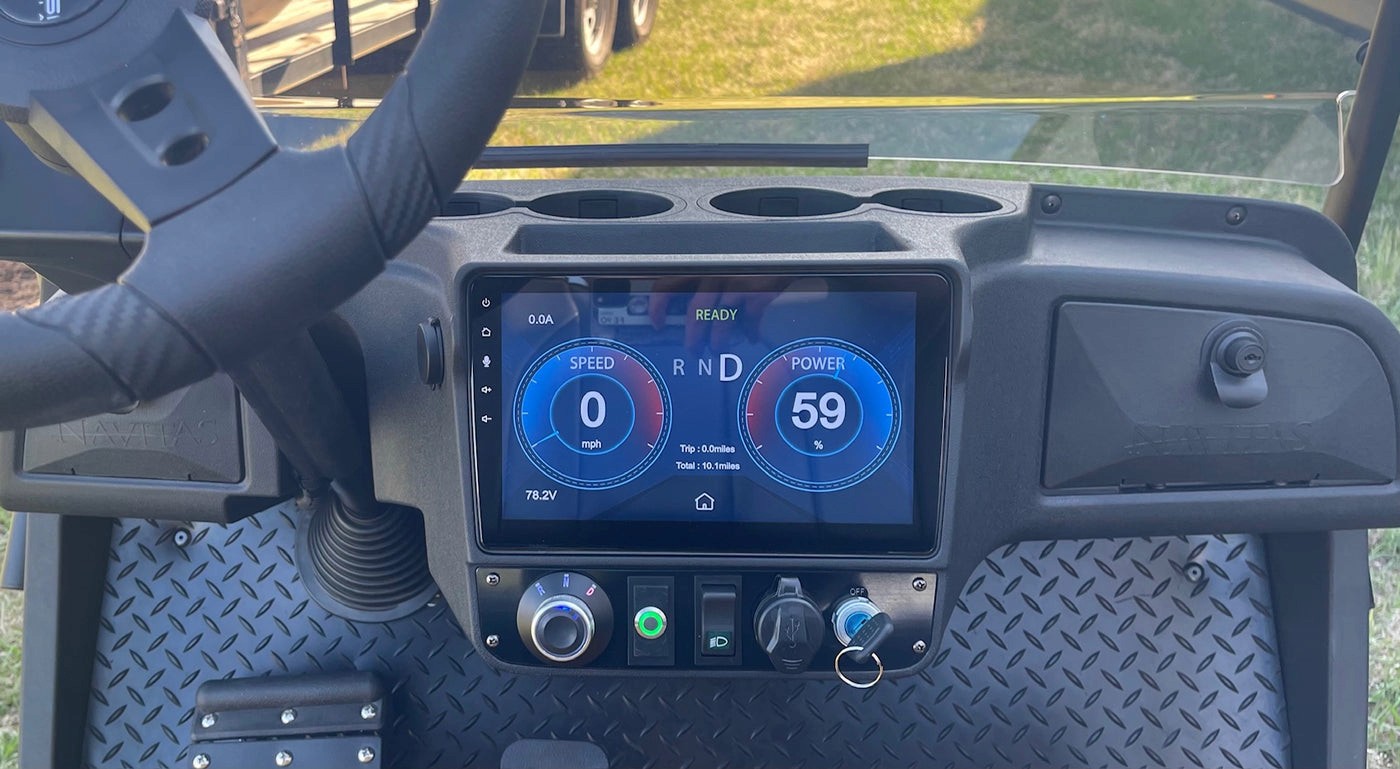
Navitas 10" CAN Display, one of the visible options in this category
What Buyers Actually Mean When They Search "Golf Cart Display With Apple CarPlay"
The search intent behind this keyword is broader than it looks. Buyers are usually evaluating one of these use cases:
Aftermarket replacement for an existing touchscreen
New build upgrade for a premium golf cart or LSV
OEM factory integration for a branded dashboard experience
Fleet or utility use where navigation, calls, reverse camera, and battery visibility all matter
Most product pages mention Apple CarPlay, Android Auto, screen size, and replacement compatibility and often gloss over the details that actually matter to technical buyers:
CAN bus integration
Real battery and vehicle telemetry
White-label OEM deployment
Dual Bluetooth architecture
Power input tolerance
Installation workflow for manufacturers
Long-term software ownership and customization
For technical buyers, these are not minor details. They are the difference between a gadget and a production-grade vehicle interface.
What Makes a Great Golf Cart CarPlay Display
A good display adds convenience. A great one becomes the control surface for the vehicle.
Core features that matter
Feature | Why It Matters |
|---|---|
Apple CarPlay | Gives drivers familiar access to calls, music, maps, and messaging |
Android Auto | Essential for mixed-device households and fleets |
Reverse camera support | Improves safety when parking and maneuvering |
Real-time dashboard data | Speed, gear, battery %, trip, and odometer should live in one interface |
CAN bus integration | Enables deeper communication with the vehicle, not just media playback |
Stable Bluetooth architecture | Prevents conflicts between phone calls, audio, and phone mirroring |
Broad power input | Important for LSVs and varied electric vehicle platforms |
OEM branding support | Critical for manufacturers that need a differentiated product |
Why Apple CarPlay matters specifically on golf carts and LSVs
Golf carts and LSVs are no longer just for golf courses. They now operate in gated communities, hospitality properties, campuses, industrial sites, marinas, residential neighborhoods, and commercial fleet environments.
In those environments, navigation, calling, music, messaging, and voice control are practical features, not luxuries.
Vehicle owners who use CarPlay reported higher satisfaction with their in-car infotainment systems, scoring an average of 840 out of 1,000, compared to 805 for those using built-in systems.
The Problem With Many Aftermarket Golf Cart Displays
Many displays marketed to the golf cart industry are essentially adapted consumer screens. They may look good on a product page, but in deployment they often create problems:
Weak integration with vehicle systems
Limited or unreliable battery data
Laggy UI under real use
Bluetooth instability
Minimal support for OEM DNA and branding
Inconsistent installation requirements
Poor documentation for technical teams
No meaningful customization path
That is especially risky for manufacturers. If you're building vehicles at scale, you need a display partner that understands electrical systems, embedded interfaces, firmware behavior, and production assembly not just e-commerce accessories.
Two Real-World Examples in the Market
Navitas 10" CAN Display
The Navitas 10" CAN display is positioned as a dash upgrade for golf carts and LSVs. Its published feature set includes Apple CarPlay, Android Auto, AM/FM radio, a reverse camera, Bluetooth phone and audio, USB storage, CAN battery state-of-charge support, TAC controller interface, and a 10.1-inch screen.
This is a meaningful step up from legacy golf cart displays because it recognizes that users want both infotainment and vehicle data in one place. However, its positioning is still primarily as a product component, not a deeply customizable OEM platform.
Evolution 9" D5 Touchscreen With CarPlay & Android Auto
The Evolution 9" D5 touchscreen is marketed as a direct OEM replacement for compatible D5 Ranger and Maverick carts. It adds Apple CarPlay, Android Auto, upgraded audio capability, and replacement compatibility for existing touchscreen-equipped carts.
Its value is clear for owners of those specific vehicles but it is explicitly limited: it doesn't support entertainment cluster and infotainment cluster together, so the user must choose between CarPlay and checking speed.
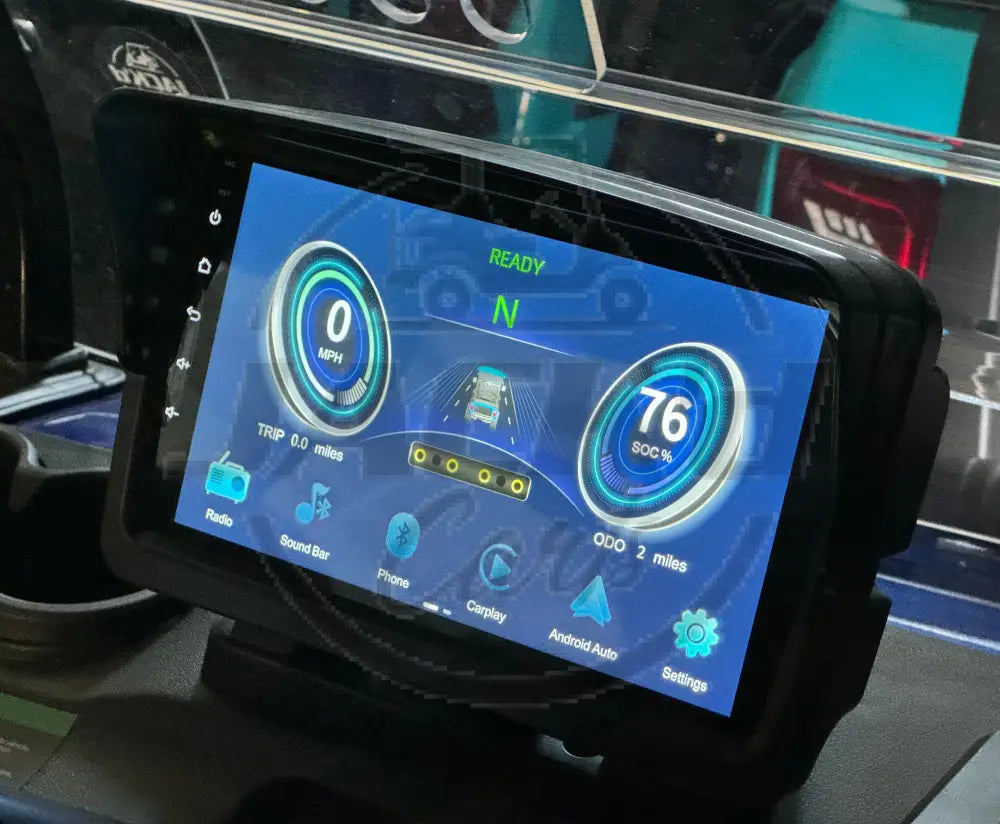
Evolution 9" D5, a model-specific OEM replacement with clear limitations
Connex Display: A Better Answer for OEMs and Premium Vehicle Programs
Where most competitor products stop at infotainment, Connex Display is built as a complete smart dashboard platform for golf carts and low-speed vehicles. For manufacturers, this is the real opportunity: not just adding Apple CarPlay, but shipping a modern branded cockpit that improves the perceived value of the entire vehicle.
What Connex Display includes
10.1-inch smart touchscreen
Wireless Apple CarPlay and Android Auto
Dual BLE architecture audio and phone mirroring do not conflict
Real-time dashboard for speed, gear, battery %, trip, and odometer
CAN bus integration
Included rear-view camera with automatic reverse activation
9V–90V DC input
Connex Linux Operating System
Access to 20+ apps including Spotify, Google Maps, Waze, and WhatsApp
OEM white-label customization
Plug-and-play installation for vehicle manufacturers
This is not a universal tablet trying to act like a dashboard. It is a vehicle-first interface engineered for actual deployment especially relevant for golf cart manufacturers, LSV brands, utility vehicle OEMs, premium fleet builders, and mobility platforms that need branded digital interfaces.
For a deeper feature-by-feature breakdown, see Connex vs Navitas.
Connex Display vs Typical Golf Cart CarPlay Screens
Capability | Typical Aftermarket Screen | Connex Display |
|---|---|---|
Apple CarPlay | Usually yes | Yes, wireless |
Android Auto | Sometimes | Yes, wireless |
Vehicle telemetry | Limited | Real-time dashboard with CAN support |
Reverse camera | Often optional | Included, auto-activates in reverse |
Bluetooth stability | Can be inconsistent | Dual BLE architecture |
Power compatibility | Narrower ranges common | 9V–90V DC |
OEM branding | Rare | Full white-label support |
Vehicle-specific customization | Minimal | Yes |
Deployment model | Retail accessory | OEM-grade platform |
Operating system control | Usually opaque | Purpose-built Connex Linux OS |
Why OEMs Should Think Beyond "CarPlay Included"
For an OEM, CarPlay is not the product. It is one feature inside the product. The bigger strategic question is: what does the dashboard say about your vehicle brand?
A premium display can help you justify higher trim pricing, modernize perceived product quality, reduce the gap with passenger vehicle expectations, create a more differentiated dealer pitch, improve usability for end customers, and unlock custom workflows tied to your vehicle platform.
Built for manufacturers who think in systems
Connex Labs approaches the problem differently. As an engineering-led company, we do not treat hardware, embedded UX, AI systems, and integration as separate silos. We build systems meant to survive production, support, and scale.
What Competitor Content Usually Misses
Most articles and product pages in this category under-serve technical and commercial buyers. They focus on headline features and skip the questions that actually affect implementation.
1. Vehicle integration depth
CarPlay alone does not tell you whether the screen can read vehicle data, interact with controllers, or surface battery metrics accurately.
2. Deployment context
There is a major difference between a retail replacement screen, a dealer-installed accessory, and an OEM-installed production component.
3. Software ownership and extensibility
Can the display be customized for your product line? Can features evolve? Can your brand control the experience?
4. Reliability under real operations
A display in an LSV or utility platform needs to survive vibration, usage variation, weather exposure assumptions, power inconsistencies, and long duty cycles.
5. End-to-end partner capability
If something needs to change firmware behavior, UI logic, branding, CAN messaging, app behavior do you have access to the engineering team, or only a distributor?
How to Evaluate a Golf Cart Display With Apple CarPlay
For individual owners or dealers
Is it a direct replacement or a new install?
Does it support your exact vehicle make and model?
Is CarPlay wireless or wired?
Does it include a reverse camera?
Can it show battery state of charge accurately?
Does it support external audio systems?
What are the installation constraints?
For OEMs
Can it be white-labeled?
Can the boot screen, UI, and branding be customized?
Does it support CAN bus integration?
What are the power input tolerances?
How does it fit into the assembly process?
Can custom vehicle functions be programmed?
Who owns the software and future roadmap?
Is there a direct engineering relationship?
Best Use Cases for a CarPlay-Enabled Golf Cart Display
Residential and lifestyle LSVs
Drivers want a familiar interface for maps, calls, music, and messages.Hospitality and resort fleets
A polished display improves guest experience and supports premium branding.Campus and community mobility
Navigation and communications become more useful when carts are used as daily transport.Marina and specialty mobility platforms
Integrated displays are especially valuable where route awareness, reverse visibility, and battery monitoring matter.OEM premium trims
A smart display is one of the fastest ways to modernize the perceived quality of a vehicle line.
Which Display Is Right for You
If all you need is a basic replacement screen, there are products on the market that may do the job.
But if you are serious about vehicle experience, integration, and long-term product quality, the standard should be much higher. The best solution is not just one that runs CarPlay it is one that fits the vehicle properly, works with the electrical system, surfaces real vehicle data, supports safe reversing, delivers stable connectivity, can be branded and customized, and is backed by an engineering team that can actually support it.
That is the difference between an accessory and a platform.
Connex Display is built for manufacturers and vehicle programs that want that platform approach. If you want to explore OEM integration, white-label deployment, or custom dashboard functionality for your golf cart or LSV line, the next step is simple: contact Connex Labs.